
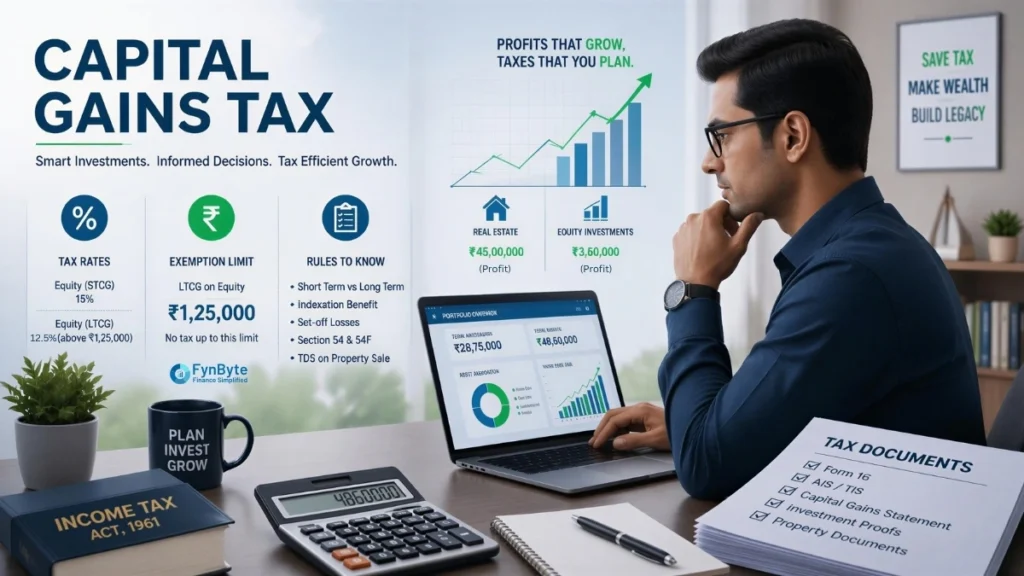

Capital gains tax sounds complicated, but with some simple explanations, anyone can understand how it works, when it applies, and what rules you need to follow—especially if you are investing or planning to sell assets like property or shares. This guide covers all the basics, including definitions, tax rates, exemptions, calculation examples, and the most important rules for Indian taxpayers.
1. What is Capital Gains Tax?
Capital gains tax is the tax you pay on profits made from selling certain types of assets. These assets, known as capital assets, can include real estate, stocks, mutual funds, gold, and more. The tax is assessed on the difference between the amount you sell the asset for and the price at which you bought it. If you sell an asset for more than what you paid, that’s a capital gain. If you sell it for less, that’s a capital loss.
Example:
- You bought 100 shares for ₹10,000.
- You sell them a year later for ₹15,000.
- Your capital gain: ₹15,000 − ₹10,000 = ₹5,000.
2. What is a Capital Asset?
A capital asset refers to property or investments you own—not just for business, but for personal wealth creation. Common examples are:
- House or land
- Stocks, bonds, or mutual funds
- Gold, jewelry, paintings
Some items are not treated as capital assets for tax purposes, including:
- Personal effects, like clothes or furniture for personal use
- Agricultural land in rural areas
- Stock and inventory held for business
3. Types of Capital Gains: Short-term vs. Long-term
The first step is to classify your gain as Short-term Capital Gain (STCG) or Long-term Capital Gain (LTCG) based on how long you held the asset before selling.
Classification Table
| Asset Type | Holding Period for LTCG | STCG if Holding Period is: |
|---|---|---|
| Listed shares/Equity MFs | > 12 months | 24 months |
4. Capital Gains Tax Rates (2025)
The tax rate varies based on type and holding period of the asset.
| Asset Type | Short-term Rate (STCG) | Long-term Rate (LTCG) | LTCG Exemption Limit |
|---|---|---|---|
| Listed shares/Equity MFs | 15% (STT paid) | 12.5% above ₹1.25 lakh | ₹1.25 lakh |
| Real estate (property) | Slab rate (added to total income) | 20% | None |
| Gold, other assets | Slab rate (as per income tax slab) | 20% | None |
- Slab rate means the gain is taxed according to your overall income bracket.
- From Budget 2024, indexation benefit (adjusting for inflation) for some assets is restricted.
5. Exemption Limits and Tax Relief
Exemption Limit on LTCG (Equity)
If your long-term capital gains from the sale of listed equity shares or equity mutual funds in one year are up to ₹1.25 lakh, you pay no tax on that amount. Only gains above ₹1.25 lakh are taxed at 12.5%.
Other Exemptions (Sections 54, 54EC, 54F)
The Income Tax Act provides relief if you reinvest your capital gains:
- Section 54: If you sell a house and buy another within specific timeframes, you can get exemption on LTCG.
- Section 54EC: Invest your gain in specified bonds (like NHAI or REC) within 6 months to get exemption (up to ₹50 lakh).
- Section 54F: If you sell any other asset (other than house property) and buy a residential house, you may claim exemption.
6. Essential Rules for Capital Gains Tax
- Indexation: For some long-term gains (mainly property, gold), you can increase the cost of acquisition to adjust for inflation, reducing your tax liability. From 2024, this is withdrawn for certain assets.
- Losses: If your capital loss (STCL/LTCL), it can generally be set off against capital gains of the same or lower kind, and unabsorbed loss can be carried forward for 8 years.
- Inherited Assets: If you inherit an asset, capital gains tax applies only when you sell it—not when you receive it. The holding period of the previous owner is counted.
- Reporting: All taxable capital gains/losses must be reported in your income tax return, using the correct ITR form.
7. How to Calculate Capital Gains Tax
Steps for Calculation
- Determine Sale Value
- Subtract:
- Cost of acquisition (purchase price)
- Transfer expenses (brokerage, legal fees)
- Improvement costs (if any, for property)
- Indexation benefit (only for eligible LTCG)
Short-Term Capital Gain Calculation:
Short-Term Capital Gain = Sale Price – (Purchase Price + Expenses + Improvement Costs)Long-Term (with Indexation) Calculation:
LTCG = Sale Price – (Indexed Purchase Price + Indexed Improvement Costs + Expenses)Indexed Price = Actual Price × (Cost Inflation Index for Sale Year / CII for Purchase Year)
Example 1 (STCG)
- Buy property in January 2021 for ₹50 lakh
- Spend ₹5 lakh on improvements
- Sell in November 2022 for ₹65 lakh
- Holding: 22 months (short-term)
Calculation:
| Particulars | Amount |
|---|---|
| Sale Value | ₹65 lakh |
| Cost of Acquisition | ₹50 lakh |
| Improvement Cost | ₹5 lakh |
| Net Short-term Capital Gain | ₹10 lakh |
Tax: If STCG applies to property, the gain is added to your total income and taxed as per your slab.
Example 2 (LTCG on Equity)
- Buy listed shares in March 2022 for ₹3 lakh
- Sell in April 2024 for ₹6 lakh (after 24 months)
Gain: ₹6 lakh − ₹3 lakh = ₹3 lakh
Free LTCG exemption: ₹1.25 lakh
Taxable LTCG: ₹3 lakh − ₹1.25 lakh = ₹1.75 lakh
Tax Payable: 12.5% of ₹1.75 lakh = ₹21,875
You Might Also Like
- What is an Emergency Fund and Why Do You Need One?
- How to Build Your Emergency Fund in 5 Simple Steps
- Warren Buffett’s 5 Golden Rules Explained with Real-Life Examples
8. Essential Compliance Tips
- Classify your asset and holding period correctly
- Keep documentation: purchase, sale deeds, STT paid/receipts, expenses receipts
- Claim eligible exemptions in your ITR
- Report all gains/losses honestly, even if no tax is due
- Set off allowable losses to save tax
Mistakes are common when calculating holding periods or ignoring indexation rules. If in doubt, consult a tax professional.
9. Key Updates for 2024–2025
- LTCG rate on listed shares/equity MFs is now 12.5% (up from 10%) on gains over ₹1.25 lakh.
- STCG rates for these remain at 15%.
- Indexation benefit is withdrawn for many assets except property and some others.
- Budget changes frequently update limits—so check latest government notifications before filing returns.
Conclusion
Capital gains tax is all about the profit you make when you sell assets. Knowing your asset type, how long you held it, and how to calculate your gain helps you make smart tax decisions. Always check for any government updates and keep your records in order for easy tax filing. If your case is complex, consider a professional’s advice for maximum tax efficiency.
Frequently Asked Questions
1. If I receive a gift of property, do I pay capital gains tax?
No. You pay tax only when you sell it, based on the original owner’s acquisition cost and holding period.
2. Do I need to pay capital gains tax every time I sell shares?
Only if you make a profit. Losses can be carried forward for 8 years.
3. Do I have to pay capital gains tax if the sale amount is below exemption limit?
For listed equity/ equity MFs, gains up to ₹1.25 lakh are tax-free in a year.