

Needs: rent, bills, groceries
Wants: dining, subscriptions, fun
Savings: invest, debt, emergency fund
50/30/20 Rule Budget Calculator: Free Monthly Budget Planner
Managing personal finances often feels like trying to solve a puzzle with missing pieces. If you are tired of complex spreadsheets, using a smart 50/30/20 rule budget calculator is the streamlined solution you need. Think of this tool not just as a basic calculator, but as a free monthly budget planner designed to help you balance instant gratification with long-term financial security effortlessly.
What is a 50/30/20 Rule Budget Calculator?
The 50/30/20 Rule Budget Calculator is a digital financial planning tool designed to divide your after-tax income into three distinct spending categories: Needs, Wants, and Savings.
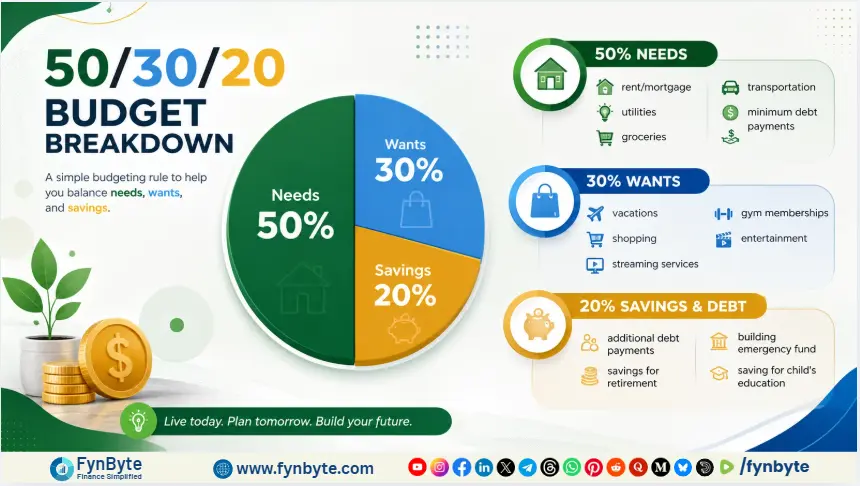
Popularized by Senator Elizabeth Warren in her book All Your Worth: The Ultimate Lifetime Money Plan, this budgeting framework is built on structural simplicity. Rather than tracking every single penny across dozens of hyper-specific categories (like groceries, coffee, or streaming services), the calculator aggregates your income into three macro-buckets:
- 50% for Needs: Essential expenses required for survival and basic livelihood.
- 30% for Wants: Lifestyle choices, entertainment, and non-essential luxuries.
- 20% for Savings: Financial goals, debt reduction, and investments.
The calculator automates the mathematical heavy lifting. By inputting your net income, it instantly reveals your personalized spending limits, giving you a clear roadmap to financial health without the cognitive overload.
Features of a 50/30/20 Rule Budget Calculator
An advanced financial tool should do more than basic division. High-performing calculators offer features engineered to provide clarity and actionable insights:
- Real-Time Automated Allocation: As soon as you enter your monthly take-home pay, the tool instantly splits the total into your 50%, 30%, and 20% thresholds.
- Dual Input Mechanics: Accommodates both fixed monthly salaries and variable hourly wages, adjusting seamlessly for freelancers or gig economy workers.
- Visual Data Breakdowns: Interactive pie charts and progress bars offer a glanceable view of your financial distribution, which improves comprehension.
- Dynamic Customization: Allows you to break down sub-categories within the three main buckets (e.g., separating rent from groceries under “Needs”) to ensure precision.
- Mobile-Responsive Design: Enables you to check your budget limits on the go, whether you are buying groceries or contemplating a luxury purchase.
How Can a 50/30/20 Budget Calculator Help You?
Living without a budget is like driving through a storm without windshield wipers. You might move forward, but you are highly likely to crash. Here is how this specific calculator alters your financial trajectory:
Eliminates Budgeting Fatigue
Traditional budgeting fails because it requires meticulous, daily tracking that feels like a chore. This calculator focuses on the big picture. Once you know your macro-limits, daily decision-making becomes significantly less stressful.
Curbs Guilt-Free Spending
Many people feel anxious when spending money on entertainment or hobbies. Because the calculator allocates a dedicated 30% to your “Wants,” you can enjoy your dinners out, vacations, or hobbies guilt-free, knowing your bills and savings are already accounted for.
Accelerates Financial Freedom
By safeguarding 20% of your income for the future, the calculator builds a systematic wealth accumulation habit. It ensures you pay yourself first, building an emergency cushion and investing for retirement before you have the chance to overspend.
How Does a 50/30/20 Rule Budget Calculator Work?
When you look at how a 50 30 20 budget calculator works, the magic lies in the automation. A standard 50/30/20 budget calculator takes your entire net income and splits it into macro-buckets instantly.
The Mathematical Formula
Behind the user-friendly interface of our income allocation calculator lies a simple mathematical formula. The calculator applies percentage targets to your net income, which is your total take-home pay after taxes, health insurance premiums, and automatic retirement deductions have been removed.
Let Net Income = I
- Needs = I×0.50
- Wants = I×0.30
- Savings/Debt = I×0.20
Deep Dive Into the Three Buckets
| Category | Percentage | What It Includes | What It Excludes |
| Needs | 50% | Rent/Mortgage, Utilities, Groceries, Minimum Debt Payments, Insurance, Transportation | Dining out, organic specialty foods, premium cable packages |
| Wants | 30% | Restaurants, Concerts, Travel, Streaming Services, Designer Clothes, Upgraded Tech | Basic internet (if working from home), basic grocery staples |
| Savings & Debt | 20% | Emergency Fund, 401(k) / IRA Contributions, Extra Principal Debt Paydowns, Stocks/ETFs | Minimum monthly credit card payments (these belong in Needs) |
How to Use the FynByte 50/30/20 Rule Budget Calculator as a Monthly Budget Planner
The FynByte 50/30/20 Rule Budget Calculator is optimized for speed, precision, and an exceptional user experience. Follow these simple steps to map out your monthly income:
1. Calculate Your Net Income
Look at your most recent pay stub. Use the exact figure that hits your bank account. If you are a freelancer, subtract your estimated tax withholdings first.
2. Input Your Income
Enter this total amount into the primary input field of the FynByte calculator.
3. Review the Baseline Allocation
The tool will instantly generate your dollar limits for Needs, Wants, and Savings.
4. Itemize Your Expenses (Optional)
Use FynByte’s granular breakdown tool to list your specific bills. The calculator will alert you if your actual “Needs” exceed the 50% threshold.
5. Adjust and Pivot
If your current spending doesn’t align with the ideal breakdown, use the results to identify where to trim expenses.
Real-World Example of Using the Free Budget Calculator
To understand the practical impact of this tool, let’s look at a realistic scenario featuring a young professional named Sarah.
Sarah is a marketing specialist who earns a gross annual salary of $65,000. After federal, state, and local taxes, her monthly take-home pay (Net Income) is exactly $4,200.
When Sarah types $4,200 into the calculator, it outputs the following monthly roadmap:
[Total Net Income: $4,200]
 ├── Needs (50%): $2,100
 ├── Wants (30%): $1,260
 └── Savings (20%): $840
Sarah’s Financial Breakdown
- Needs ($2,100): Sarah allocates $1,300 for rent, $300 for groceries, $200 for utilities/internet, and $300 for her car payment and insurance. She fits perfectly within her limit.
- Wants ($1,260): This covers her morning coffee runs, weekend dinners with friends, a gym membership, and shopping trips.
- Savings ($840): She automatically sends $400 to her high-yield emergency fund and routes $440 into her retirement investment account.
By visualizing these numbers clearly, Sarah avoids lifestyle creep and ensures her future is secure without sacrificing her present social life.
Advantages of Using a 50/30/20 Budget Calculator
Why should you choose this system over traditional cash envelope methods or zero-based budgeting models?
- Unmatched Simplicity: It requires minimal upkeep. You only need to re-calculate when your income changes or when you experience a major life shift.
- Flexible and Adaptable: It adapts to your location and income level. Whether you make $3,000 a month or $30,000, the mathematical ratios scale with your life.
- Encourages Realistic Financial Habits: Strict budgets fail because they deny human desires. By protecting 30% of your income for enjoyment, this model prevents the financial equivalent of “binge eating” after a crash diet.
- Highlights Financial Red Flags: If you enter your income and find your rent alone eats up 60% of your check, the calculator gives you immediate proof that your fixed costs are unsustainably high.
Frequently Asked Questions (FAQ)
1. What if my needs exceed 50% of my income?
This is common in high-cost-of-living areas. If your needs consume 60% or 70% of your income, you must temporarily pull funds from your 30% “Wants” bucket to cover them. Use the calculator as an indicator that you may need to downsize fixed costs or look for ways to increase your income.
2. Should my 401(k) contributions be included in the 20% savings bucket?
Yes. If your retirement contributions are deducted directly from your paycheck, add that amount back to your net income to find your true baseline, and then count those deductions toward your 20% savings target.
3. Is the 50/30/20 rule suitable for people with significant debt?
If you have high-interest toxic debt (like credit card debt), your minimum payments are considered “Needs.” However, any extra payments you make to wipe out the balance faster should come directly out of your 20% “Savings” bucket.
4. Can I use this calculator if my income changes every month?
Absolutely. If you have an irregular income, use the calculator to find an average based on your lowest-earning months, or run your numbers at the beginning of every month as soon as your income is finalized.
Is the 50/30/20 rule realistic for low-income earners?
It can be challenging if survival costs absorb most of your income. If the exact 50/30/20 split is out of reach right now, you can adjust the ratios to a 70/20/10 or 60/20/20 model while using the tool to track your progress over time.
Is the 50/30/20 Budget Calculator are free?
Yes, 100% 50/30/20 Budget Calculator is free, all you need is just input your income and get the result instantly.