

The smartest way to pay off credit card debt is to stop charging new purchases and deploy either the Debt Avalanche method (paying high-interest cards first to save money) or the Debt Snowball method (paying smallest balances first for psychological wins). For high-interest balances, strategic tools like 0% APR balance transfer cards or low-rate debt consolidation loans can radically accelerate your progress.
The Hidden Weight of Plastic
Credit cards are one of the dual-edged swords of modern finance. Used correctly, they build credit and earn rewards. Used poorly, they become a compounding financial trap. Because of the way credit card interest compounds, carrying a balance means you are paying a premium on every coffee, grocery run, or vacation long after the purchase is over.
If you are feeling buried by monthly minimums, you are far from alone. Getting out of debt isn’t just about math; it is about behavior, habits, and strategy. This comprehensive guide breaks down the absolute smartest ways to pay off your credit card debt, save thousands in interest, and construct a bulletproof financial foundation.
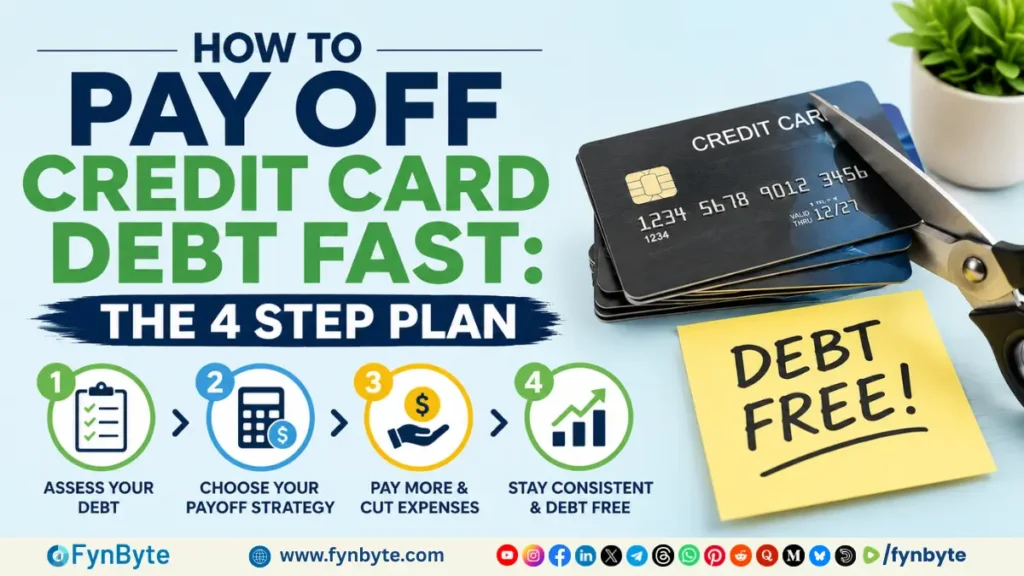
How to Pay off Credit Card Debt Fast: The 4 Step Process
Step 1: Face the Numbers (The Debt Inventory)
Before choosing a battlefield strategy, you need to map out the entire terrain. Many people avoid looking at their bank accounts out of anxiety, but clarity is your greatest asset.
Grab a spreadsheet or a piece of notebook paper and list every single credit card balance you owe. Do not rely on guesses. Log into your portals and write down three specific metrics for each card:
- The total current balance (How much you owe in total)
- The Annual Percentage Rate (APR) (The interest rate)
- The minimum monthly payment (The bare minimum required to keep the account current)
Calculating Your Total Baseline
Add up all your minimum payments. This number is your monthly survival baseline. To make any strategy work, you must be able to cover this total baseline every single month to avoid late fees and severe credit score damage. Any money you can scrape together above this baseline is your “debt-fighting pool”—the extra cash you will use to actively attack your balances.
Step 2: Avalanche vs. Snowball (The Core Repayment Frameworks)
Once your numbers are organized, it is time to choose your weapon. The financial world generally split into two highly effective schools of thought: The Debt Avalanche and The Debt Snowball.
   DEBT AVALANCHE (Mathematical Focus)
   [Attack Highest Interest Rate First] ---> Saves the most money long-term

   DEBT SNOWBALL (Psychological Focus)
   [Attack Smallest Balance First]    ---> Builds quick momentum & habits
Both strategies require you to pay the minimum balances on all cards except one. All of your extra debt-fighting cash is funneled directly into that single target card until it hits zero.
The Debt Avalanche: The Mathematical Choice
The Debt Avalanche method focuses strictly on the interest rates.
- How it works: You list your cards from the highest APR to the lowest APR. You throw all your extra money at the card with the highest interest rate while paying the minimums on the rest.
- The Benefit: Mathematically, this is the absolute smartest way to pay off credit card debt. By crushing the most expensive debt first, you prevent the maximum amount of interest from compounding.
- The Catch: If your highest-interest card also happens to have a massive balance, it might take months or even a year to see it hit zero. You have to stay motivated without immediate visual wins.
The Debt Snowball: The Psychological Choice
The Debt Snowball method focuses on human behavior and quick victories.
- How it works: You list your debts from the smallest balance to the largest balance, regardless of the interest rates. You attack the smallest balance first.
- The Benefit: You score a quick win within the first month or two. Eliminating an entire account completely frees up cash flow and gives you a powerful psychological boost. You feel like you are winning, which encourages you to keep going.
- The Catch: Because you might leave a high-interest card sitting on the back burner while you pay off a tiny, low-interest balance, this method can cost you more in total interest over time.
Key Takeaway Box: Choose the Avalanche if you are disciplined and motivated by pure math. Choose the Snowball if you easily get discouraged and need quick, tangible milestones to stay on track. The “smartest” method is simply the one you can stick with until the end.
Step 3: Accelerate Your Progress with Debt Optimization Tools
If your credit score is still in decent shape (generally a 670 or higher), you do not have to fight the high-interest battle empty-handed. You can use financial optimization tools to lower your interest rates, ensuring more of your hard-earned money goes toward the principal balance rather than interest fees.
1. 0% APR Balance Transfer Credit Cards
A balance transfer card allows you to move your high-interest debt onto a new card that charges 0% interest for a promotional period, usually lasting between 12 and 21 months.
- The Strategy: If you transfer $5,000 to a 21-month 0% APR card, every single dollar you pay goes directly toward wiping out that $5,000 principal.
- The Cost: Most cards charge a upfront balance transfer fee of 3% to 5% of the total amount transferred.
- The Warning: If you do not pay off the balance before the promotional window closes, the remaining balance will be hit with a standard, high credit card APR. Worse, if you run up new debt on the old cards you just cleared, you will double your total debt.
2. Debt Consolidation Loans
A debt consolidation loan is a personal loan used to pay off all your credit cards at once. This leaves you with one single fixed monthly payment and a clear end date (usually 2 to 5 years).
- The Strategy: Credit cards have variable interest rates that can skyrocket over 20-25%. Personal loans offer fixed interest rates that are often significantly lower for well-qualified borrowers.
- The Benefit: It streamlines your finances down to one predictable payment and instantly lowers your credit utilization ratio, which can give your credit score a major boost.
- The Warning: A consolidation loan solves the symptom of debt, not the habit of spending. You must commit to keeping your credit cards tucked away so you don’t run up balances while simultaneously paying off the loan.
Step 4: Optimize Cash Flow and Stop the Bleeding
No debt payoff strategy will work if you are continuing to add new charges to your accounts. You must freeze your credit card usage immediately.
Strategies to Increase Your Monthly Debt-Fighting Pool
To pay off debt quickly, you need to widen the gap between your income and your expenses. Here are highly practical ways to find extra cash:
- Audit Your Subscriptions: Go through your bank statements and cancel every automated subscription you haven’t used in the last 30 days (streaming apps, software, gym memberships).
- The 48-Hour Rule: For non-essential purchases, force yourself to wait 48 hours before buying. This simple pause destroys the impulse-spending loop.
- The Temporary Side Hustle: Dedicate 5-10 hours a week to freelancing, ride-sharing, or selling unused items around your house. Every single dollar from this stream should go directly toward your target debt.
Also Read:
- 10 Best Budgeting Apps In The USA (2026 Review & Comparison)
- What Is Debt Consolidation: How Does It Works?
Comparison Table: Which Debt Solution Fits Your Profile?
| Strategy / Tool | Best Suited For | Primary Benefit | Core Risk |
|---|---|---|---|
| Debt Avalanche | Analytical minds, high-interest balances | Saves the most money on interest | Requires patience; slow initial wins |
| Debt Snowball | People needing behavioral motivation | Fast psychological victories | Costs more in total interest |
| 0% APR Balance Transfer | Good credit scores (670+), mid-sized debt | Zero interest for up to 21 months | Missed window triggers high APR |
| Debt Consolidation Loan | Large debts across many different cards | Single fixed payment, lower fixed rate | Temptation to reuse cleared cards |
Conclusion: Crafting Your Action Plan
The smartest way to pay off credit card debt isn’t a secret formula; it’s a mix of strategic focus and behavioral discipline. Stop using the cards, list your balances, choose between the Avalanche and Snowball methods, and evaluate if a balance transfer or consolidation loan can speed up your timeline.
Remember, debt repayment is a marathon, not a sprint. Every payment you make cracks open the door to true financial freedom, less daily stress, and a secure future. Pick your strategy today, automate your minimum payments, and take your first step toward financial peace of mind.
Frequently Asked Questions (FAQs)
1. What is the absolute fastest way to pay off credit card debt?
The fastest way to pay off credit card debt is to combine the Debt Avalanche method with an aggressive budget reduction or side hustle. By pairing extra income with a strategy that attacks your highest-interest balances first, you minimize total interest charges and ensure every dollar goes directly to lowering the actual principal.
2. Is it better to pay off debt or save money first?
You should build a minimal emergency fund of $1,000 to $1,500 before aggressively tackling high-interest credit card debt. This small cash buffer ensures that if an unexpected expense arises—like a car repair or medical bill—you won’t be forced to borrow money and add to the credit card debt you are trying to destroy. Once that starter fund is secure, funnel all extra cash into your debt.
3. Can I negotiate my credit card interest rates down?
Yes. You can call your credit card company, ask for the retention or customer service department, and request a lower APR. If you have a solid history of on-time payments, mention that you are evaluating balance transfer offers from competing banks. Companies will frequently lower your rate by a few percentage points to keep you as a loyal customer.
4. Does closing a credit card help you pay it off?
No, closing a credit card does not erase the balance; you still owe the money. In fact, closing an active card can hurt your credit score by reducing your total available credit, which instantly increases your credit utilization ratio (how much debt you owe compared to your total limit). Keep the account open but completely stop charging items to it.