
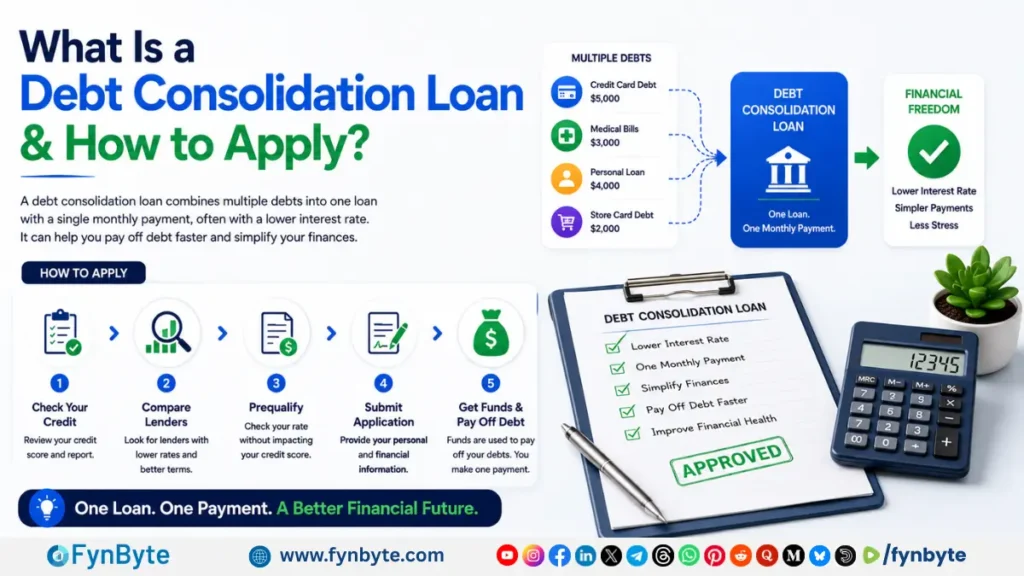

A debt consolidation loan is a personal loan used to combine multiple high-interest debts—like credit cards or medical bills—into a single monthly payment, ideally with a lower interest rate. This financial strategy simplifies your monthly budgeting and can help you clear debt faster while saving money on interest.
The Weight of Scattered Debt
Imagine trying to juggle five tennis balls at once. Every ball represents a different credit card statement, a personal loan, or a medical bill. Each one has its own due date, its own minimum payment, and its own sky-high interest rate. It takes only one dropped ball—a missed payment or a late fee—to send your financial life into a tailspin.
If you are feeling overwhelmed by scattered monthly payments, you are far from alone. Managing multiple debt streams is mentally draining and financially expensive.
Fortunately, there is a way to catch all those juggling balls and place them neatly into one basket. It is called a debt consolidation loan.
In this comprehensive guide, we will break down exactly how debt consolidation works, the pros and cons you need to consider, and how to determine if it is the right move for your financial future.
What is a Debt Consolidation Loan?
At its core, a debt consolidation loan is a type of personal loan that you use to pay off multiple smaller, high-interest debts. Instead of sending money to four or five different creditors every month, you take out one new loan to pay them all off at once. Moving forward, you only have to make one single payment to your new lender every month.
Think of it as a financial reset button. You are not magically wiping your debt away (you still owe the same total amount of money), but you are changing who you owe and how you pay them back.
The Ultimate Goal: Lowering Your Financial Friction
The main objective of using a debt consolidation loan is to improve your financial situation in two distinct ways:
- Simplify your life: Turning multiple bills into one single monthly payment reduces the risk of forgetting a due date.
- Save money: If your new loan has a lower interest rate than your current debts, more of your hard-earned money goes toward reducing your actual balance rather than padding a bank’s profits.
How Debt Consolidation Works: A Step-by-Step Breakdown
Understanding how a debt consolidation loan functions in the real world makes the process much less intimidating. Let’s look at a concrete, real-life scenario to see the math and mechanics in action.
The Mechanics of Consolidation
When you apply for a debt consolidation loan, a lender evaluates your credit score, income, and financial history. If approved, you receive a lump sum of money.
Depending on the lender, they will either send that money directly to your old creditors to pay off your balances, or they will drop the cash into your bank account so you can pay off those debts yourself. Once those old accounts hit a zero balance, your old debts are settled. Your focus then shifts entirely to paying off your new consolidation loan over a set period, typically ranging from two to seven years.
A Real-Life Mathematical Example
To see the true power of how this strategy can help you roll multiple debts into one and clear debt faster, let’s look at a typical financial situation.
Imagine Sarah. She has three credit cards and one medical bill that she is struggling to pay off:
| Debt Source | Current Balance | Interest Rate (APR) | Minimum Monthly Payment |
| Credit Card A | $5,000 | 24% | $150 |
| Credit Card B | $4,000 | 22% | $120 |
| Credit Card C | $3,000 | 26% | $100 |
| Medical Bill | $3,000 | 12% | $130 |
| TOTALS | $15,000 | 21.8% (Average) | $500 |
Sarah is currently paying $500 a month across four different platforms, and because her interest rates are so high, a huge chunk of that money goes straight toward interest rather than shrinking her $15,000 balance.
Now, let’s see what happens if Sarah qualifies for a $15,000 debt consolidation loan with a 12% interest rate and a 3-year (36-month) payoff term:
- New Monthly Payment: $498
- Number of Bills: 1 (instead of 4)
- Interest Saved: Thousands of dollars over the life of the debt
- Timeline: She will be 100% debt-free in exactly 36 months.
By choosing to roll multiple debts into one, Sarah keeps her monthly out-of-pocket costs practically identical ($498 vs $500), but she drastically cuts her interest rate. She now has a clear light at the end of the tunnel.
When to Use a Debt Consolidation Loan
While consolidation sounds like an easy win, it isn’t a one-size-fits-all solution. It requires a specific set of financial circumstances to make sense.
1. You Have a Good to Excellent Credit Score
Lenders reserve their lowest interest rates for borrowers with solid credit profiles (typically a credit score of 670 or higher). If your credit score has improved since you first took out your credit cards or loans, you are an ideal candidate. If your credit score is low, the interest rate offered on a consolidation loan might be just as high as your current cards, defeating the main purpose of the strategy.
2. Your Total Debt is Under 50% of Your Income
A debt consolidation loan works best for manageable amounts of consumer debt—usually between $5,000 and $50,000. If your total debt exceeds half of your annual salary, a loan might not cover it all. In those extreme cases, alternative paths like credit counseling or debt settlement might be more appropriate.
3. Your Debt Consists of High-Interest Accounts
The best way to consolidate credit card debt is to swap variable, high-interest rates for a fixed, lower rate. If your current debt consists of low-interest loans (like a 4% student loan or a 5% car loan), consolidating them into a 10% personal loan will actually cost you more money. Keep your low-interest loans where they are and focus solely on consolidating high-interest balances.
4. You Have Controlled Your Spending Habits
This is the most critical requirement. A consolidation loan frees up your credit cards’ spending limits because it pays them down to zero. If you do not have the discipline to stop charging new purchases to those newly emptied credit cards, you will quickly find yourself facing the consolidation loan payment plus a new round of credit card bills.
Key Takeaway Box: Debt consolidation is a tool to restructure your debt, not a eraser to wipe it away. It only works if you fix the root behavioral habits that caused the debt in the first place.
The Pros and Cons of Debt Consolidation Loans
Before signing any financial contract, you must weigh the benefits against the potential risks.
The Advantages (The Pros)
- One Streamlined Payment: No more tracking multiple due dates or logging into different banking portals.
- Fixed Repayment Schedule: Personal loans have a set end date. You know exactly what month and year you will be completely debt-free.
- Boost Your Credit Score: Paying off your credit cards lowers your credit utilization ratio (how much credit you are using compared to your total limit), which is a major factor in calculating your credit score.
- Lower Interest Rates: Swapping a 25% credit card APR for a 10% or 12% personal loan save you massive amounts of cash over time.
The Disadvantages (The Cons)
- Upfront Fees: Many lenders charge an “origination fee” to process the loan, which can range from 1% to 8% of the total loan amount.
- Risk of Double Debt: If you keep spending on your credit cards after they are paid off by the loan, you could double your debt load.
- Higher Total Cost Over Long Terms: If you extend your loan payoff timeline over 6 or 7 years to get a very low monthly payment, you might end up paying more total interest over time than if you had just aggressively paid off the original accounts.
Alternative Ways to Consolidate Debt
If a personal loan doesn’t sound like the right fit for your situation, there are other methods you can use to streamline your payments.
Balance Transfer Credit Cards
If you have great credit, you can apply for a balance transfer credit card that offers an introductory 0% APR period (usually lasting between 12 and 21 months). You move your high-interest debt onto this new card and pay it off aggressively without paying a single penny of interest during the promotional window.
- The Catch: You usually have to pay a 3% to 5% balance transfer fee, and if you don’t pay off the balance before the promo period ends, the interest rate will skyrocket.
Home Equity Loans or HELOCs
If you own a home with equity built up, you can borrow against that equity to pay off your unsecured debts. Because your home acts as collateral, these options offer incredibly low interest rates.
- The Catch: This is highly risky. If you fail to make your payments, the lender can foreclose on your house. You are turning unsecured debt (credit cards) into secured debt (your home).
Debt Management Plans (DMPs)
If your credit score isn’t high enough to qualify for a low-interest personal loan, you can work with a non-profit credit counseling agency. They will negotiate with your creditors to lower your interest rates and combine your debts into one monthly payment managed through the agency.
How to Apply for a Debt Consolidation Loan:Step-by-Step Checklist
If you’ve decided that a debt consolidation loan is the path forward for you, use this checklist to guide you safely through the process.
Step 1: Calculate you current debs
Add up your current debts (exact balances, due dates, and interest rates).
Step 2: Check Your Credit Score
Check your credit score to see what kind of loan rates you qualify for.
Step 3: Prequalify With Lenders & Compare Interest Rates
Prequalify with multiple lenders online to compare interest rates and fees without hurting your credit score.
Step 4: Final the Lender That Has Lower Interest Rates
Calculate the math—make sure the new loan’s interest rate is lower than your current average rate.
Step 5: Check For Hidden Charges
Read the fine print to look for hidden origination fees or prepayment penalties.
Step 6: Submit The Application
Submit a formal application with your chosen lender.
Step 7: Pay off Debt
Use the funds to pay off your old accounts immediately, then safely store your credit cards away to avoid new spending.
Conclusion: Take Control of Your Financial Future
A debt consolidation loan is one of the absolute best tools available to simplify your budget, lower your interest costs, and give you a structured pathway to financial freedom. By rolling multiple, stressful payments into one predictable monthly bill, you take back control of your financial destiny.
However, never forget that a loan is simply a tool. Its ultimate success depends entirely on your commitment to changing your spending habits, sticking to your budget, and choosing to walk a disciplined path toward long-term financial health.
Frequently Asked Questions (FAQs)
1. Will a debt consolidation loan hurt my credit score?
When you first apply, the lender will perform a hard credit pull, which can temporarily dip your score by a few points. However, in the long run, using a loan to pay off your credit card balances drastically reduces your credit utilization ratio, which almost always results in a significant net boost to your overall credit score.
2. Can I get a debt consolidation loan with bad credit?
Yes, but it is much more difficult and less cost-effective. Lenders that cater to bad-credit borrowers often charge higher interest rates and steep origination fees. If your loan’s interest rate isn’t lower than your current credit card rates, consolidation will not save you money. In this situation, look into a non-profit debt management plan instead.
3. What is the difference between debt consolidation and debt settlement?
Debt consolidation involves taking out a new loan to pay off your existing debts in full, which protects and builds your credit score. Debt settlement involves hiring a company to negotiate with your creditors to accept a partial, lump-sum payment that is less than what you actually owe. Debt settlement requires you to stop making payments, which severely damages your credit score and leaves you open to legal collections actions.