
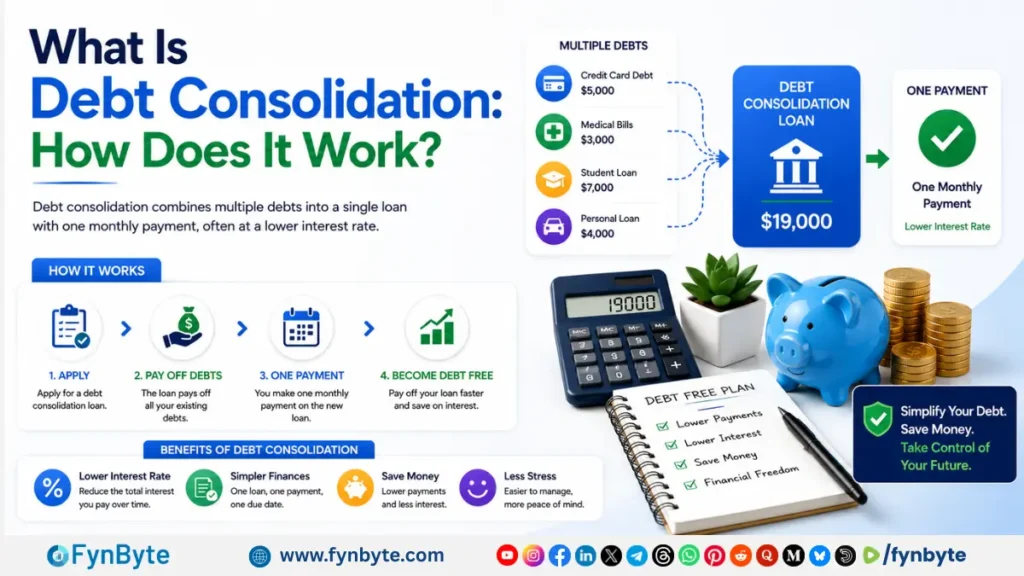

Debt consolidation is a financial strategy that rolls multiple high-interest debts—like credit cards or medical bills—into a single, single monthly payment. By using a new loan or credit card with a lower interest rate, you can simplify your finances, reduce your monthly payoff amount, and pay off your debt much faster.
The Weight of Multiple Monthly Bills
Imagine juggling five different rubber balls. Each ball represents a monthly bill: one credit card due on the 5th, a retail store card due on the 12th, a personal loan on the 18th, and a couple of medical bills scattered in between. Every ball has a different weight (your balance) and a different texture (your interest rates). If you drop just one, your credit score takes a hit, and late fees start piling up.
It is exhausting, stressful, and incredibly common.
This is exactly where debt consolidation comes into play. It is not a magical erase button for what you owe, but it is one of the most effective organizational tools available in personal finance. Instead of juggling five balls, debt consolidation catches them all and hands you one single, manageable weight.
Let’s break down exactly how this strategy works, the financial mechanisms behind it, and how you can decide if it is the right path for your financial journey.
What Is Debt Consolidation?
At its core, debt consolidation is the process of taking out a new form of credit to pay off multiple older, smaller debts. Instead of making individual payments to several different creditors every month, you use the new funds to wipe those balances to zero. Moving forward, you only have one single debt to focus on.
The main goal of this strategy is two-fold:
- To simplify your life: Managing one monthly payment is vastly easier than tracking half a dozen.
- To save money: If structured correctly, the new form of credit will have a significantly lower interest rate than the average of your current debts, saving you hundreds or thousands of dollars over time.
Key Takeaway: Debt consolidation changes who you owe and how you pay them, but it does not reduce the raw amount of money you owe. It changes the structure of your debt to make it cheaper and easier to pay off.
How Debt Consolidation Works: Step-by-Step
- Step 1: Secure a Single New Loan – You apply for a fixed-rate personal loan large enough to cover everything you owe.
- Step 2: Pay Off Old Debts – Once approved, you use the lump-sum payout to immediately clear all your high-interest credit card balances and smaller accounts to zero.
- Step 3: Repay the new loan – Instead of tracking multiple bills, you focus entirely on one consistent, predictable monthly payment until your balance is completely paid off.
Real World Example
To understand how debt consolidation works in the real world, let’s look at a quick mathematical example.
Imagine you have three credit cards:
- Card A: $3,000 balance at 24% interest
- Card B: $5,000 balance at 20% interest
- Card C: $2,000 balance at 22% interest
Total debt: $10,000 | Average interest rate: 22%
If you apply for a debt consolidation loan for $10,000 at a 10% interest rate, you use that $10,000 cash to instantly pay off Cards A, B, and C. Your credit card balances drop to zero. Now, you owe $10,000 on your new loan, but your interest rate dropped from 22% to 10%.
Because the interest rate is cut in half, more of your monthly payment goes toward the actual balance (the principal) rather than profit for the bank. You will pay off the debt much faster and keep more money in your pocket.
Popular Methods to Combine Multiple Debts
There is no one-size-fits-all approach to consolidating your liabilities. Depending on your credit score, total debt amount, and financial habits, a few distinct paths are available.
1. Unsecured Debt Consolidation Loans
This is the most common route. You apply for a personal loan from a bank, credit union, or online lender. If approved, the lender gives you a lump sum of money, which you use to clear your high-interest debt. You then repay the personal loan in fixed monthly installments, typically over two to seven years.
- Pros: Fixed interest rates, predictable monthly payments, and a clear end date for when you will be debt-free.
- Cons: Requires a good to excellent credit score to secure the lowest, most competitive interest rates.
2. 0% APR Balance Transfer Credit Cards
If your total debt is relatively small (usually under $5,000 to $10,000) and you have good credit, a balance transfer card is an incredibly powerful tool. These are special credit cards that offer an introductory 0% interest rate on transferred balances for a set period, usually 12 to 21 months.
- Pros: You pay zero interest on your debt during the promotional period, meaning 100% of your payment eats away at your balance.
- Cons: If you don’t pay off the balance before the promo period ends, the interest rate spikes significantly. Most cards also charge a balance transfer fee (typically 3% to 5% of the total amount transferred).
3. Home Equity Loans or HELOCs
If you own a home with equity built up, you can borrow against that equity to pay off your unsecured debts. Home equity loans offer some of the lowest interest rates available because they are secured by your house.
- Pros: Very low interest rates and access to large sums of cash.
- Cons: High risk. Because your home serves as collateral, failing to make your payments means the lender could foreclose on your house.
The Pros and Cons of Consolidating Debt
While the benefits of simplifying your finances are clear, debt consolidation is a financial tool—and like any tool, it can cause damage if used incorrectly.
The Benefits
- A Single, Predictable Payment: No more calendar tracking or missing due dates. One date, one amount.
- Lower Overall Interest Rate: Swapping a 25% credit card rate for an 11% personal loan rate significantly reduces the lifetime cost of your debt.
- Boosted Credit Score (Long Term): Paying off your credit cards lowers your credit utilization ratio (how much of your available credit you are using), which is a massive factor in your credit score.
- A Light at the End of the Tunnel: Personal loans have a fixed lifespan. You know exactly the month and year you will be entirely debt-free.
The Risks and Pitfalls
- It Doesn’t Fix the Root Cause: If you consolidate your cards but don’t fix the overspending habits that caused the debt, you may end up running up balances on those empty cards again. Now, you have a consolidation loan and new credit card debt.
- Upfront Fees: Personal loans often carry “origination fees” (1% to 8%), and balance transfer cards charge transfer fees. Always calculate these costs beforehand to ensure you are actually saving money.
- Potential to Pay More Long-Term: If you extend your repayment timeline too far (e.g., stretching a 2-year credit card payoff into a 7-year personal loan), you might pay more total interest over time, even with a lower rate.
Is Debt Consolidation Right for You?
Before jumping into an application, take a step back and look at your financial health. This strategy generally works best if you meet the following criteria:
- Your total debt is under 50% of your annual income: If your debt exceeds this, you might need to look into more aggressive relief options like debt management plans or bankruptcy.
- Your credit score is solid: You need decent credit to get an interest rate lower than what you are currently paying.
- Your cash flow can cover the new payment: Ensure your budget comfortably accommodates the new monthly payment.
- You have a plan to address your spending: You are committed to putting the credit cards away while paying down the new loan.
Also Read: What is an Emergency Fund and Why It Is Important?
Actionable Steps to Start Consolidating Your Debt
If you have decided that consolidation is your best next step, follow this structured blueprint to execute the plan cleanly:
- Audit Your Debt: Write down every debt you owe, its exact balance, and its current interest rate. Add the balances together to get your target loan amount.
- Check Your Credit Score: Know your starting point. This tells you what types of loans or balance transfer cards you realistically qualify for.
- Shop Around and Pre-Qualify: Look at banks, credit unions, and reputable online lenders. Many lenders allow you to “pre-qualify” to see estimated rates using a soft credit pull, which won’t hurt your credit score.
- Compare the Math: Ensure the new loan’s interest rate and fees are lower than your current average rate.
- Apply and Close: Once approved, use the funds to immediately pay off your old accounts.
- Automate Your Future: Set your new, single monthly payment to “Auto-Pay.” This guarantees you will never hit a late fee or miss a payment again.
Frequently Asked Questions (FAQs)
1. Does debt consolidation hurt your credit score?
Initially, yes, but only slightly. When you apply for a new loan or credit card, the lender performs a hard inquiry, which can temporarily dip your score by a few points. However, in the long term, using a loan to clear your credit card balances drastically lowers your credit utilization rate, which generally results in a massive, positive spike to your score within a few months.
2. What is the difference between debt consolidation and debt settlement?
These terms are often confused, but they are completely different. Debt consolidation combines your debts into a new loan that you fully intend to pay back at a lower interest rate; it keeps your credit healthy. Debt settlement involves hiring a company to negotiate with your creditors to let you pay back less than what you actually owe. Debt settlement severely damages your credit score and usually requires you to stop making payments altogether, leading to collections and penalties.
3. Can I consolidate my debt if I have bad credit?
Yes, but it is more challenging. Lenders view borrowers with lower credit scores as higher risk, meaning they charge higher interest rates. If your bad-credit consolidation loan offers an interest rate that is higher than your current credit cards, it is not worth doing. In this scenario, you may want to look into a co-signer or seek out a non-profit credit counseling agency for a structured Debt Management Plan (DMP).
4. Can I still use my credit cards after consolidating them?
Technically, yes, because your accounts remain open. However, doing so is highly risky. The biggest trap of debt consolidation is freeing up your credit card limits, feeling a false sense of financial freedom, and using those cards to spend money you don’t have. To ensure success, leave the cards open to help your credit score history, but physically hide them or freeze them in a block of ice so you aren’t tempted to use them.