
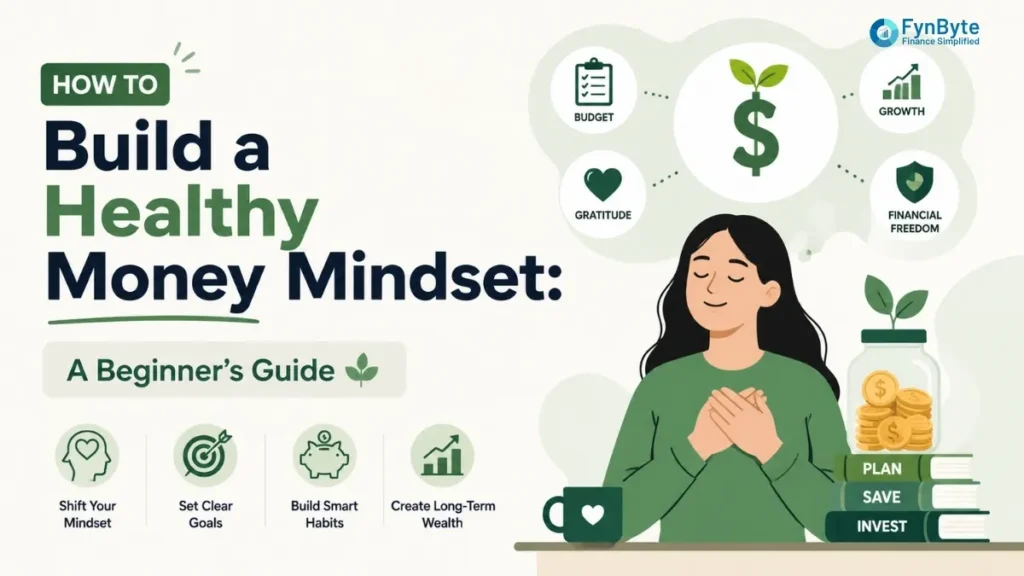

A healthy money mindset is the belief that you can manage, grow, and make smart decisions about money — regardless of your current income. It starts with understanding your existing money beliefs, replacing negative patterns with positive ones, and building simple financial habits one step at a time.
If you’ve ever thought “I’m just bad with money” — you’re not alone. Millions of people carry limiting beliefs about finances without even realizing it. The good news? A healthy money mindset is not something you’re born with. It’s something you build.
In this guide, you’ll learn exactly what a money mindset is, why yours might be holding you back, and the step-by-step way to change it — starting today.
What Is a Healthy Money Mindset — and Why Does It Matter?
Definition: A money mindset is the set of beliefs, attitudes, and habits you have around money. A healthy money mindset means you view money as a tool — not a source of stress or shame.
Your mindset around money directly shapes how you earn, spend, save, and invest. Two people with the same income can end up in completely different financial situations based entirely on their mindset.
Real-world example: Sarah earns $45,000/year. She believes money is scarce, so she spends immediately out of fear it will run out. Her coworker Tom, also earning $45,000, believes money can grow — so he saves 10% every month and invests the rest. After 5 years, Tom has $30,000+ in savings. Sarah has $200.
Signs You Have a Negative Money Mindset
- You feel anxious or guilty when spending money
- You avoid checking your bank account
- You believe rich people are lucky or dishonest
- You say things like “I’ll never be good with money”
- You spend impulsively when stressed
Signs You Have a Healthy Money Mindset
- You track your spending without judgment
- You see money as a resource you can grow
- You set financial goals and feel excited about them
- You separate your self-worth from your net worth
- You invest in learning about personal finance
Where Does Your Money Mindset Come From?
Before you can change your mindset, you need to understand where it came from. Most money beliefs are formed in childhood — often before age 10.
The 3 Biggest Sources of Money Beliefs
1. Your Family: Did your parents argue about money? Were you told “money doesn’t grow on trees”? These phrases become your internal money scripts.
2. Your Culture: In some cultures, talking about money is taboo. In others, wealth is celebrated. Cultural messaging shapes what you believe is possible.
3. Your Personal Experiences: A job loss, debt, or even a windfall can create strong emotional associations with money — positive or negative.
How to Build a Healthy Money Mindset: Step-by-Step Guide
Here’s a practical, beginner-friendly framework you can start using immediately.
Step 1 — Identify Your Current Money Beliefs
Write down 5 things you believe about money. Don’t filter. Just write. Then ask yourself: “Is this belief helping me or hurting me?”
Example: “Money is the root of all evil” → Hurting
Example: “Money is a tool I can use to create freedom” → Helping
Step 2 — Rewrite Your Money Story
For every negative belief, write a new, realistic one. You’re not just replacing it with toxic positivity — you’re replacing it with truth.
Old: “I’m always broke.”
New: “I’m building better financial habits each day.”
Old: “Rich people are greedy.”
New: “Wealth can be built ethically through value and discipline.”
Step 3 — Start Tracking Your Money (No Judgment)
You cannot manage what you don’t measure. The goal isn’t to judge yourself — it’s to understand your patterns.
Use a simple spreadsheet or app (YNAB, Mint, or even Google Sheets)
Track every rupee/dollar in and out for 30 days
Notice patterns, not problems
Step 4 — Build One Financial Habit at a Time
Don’t overhaul everything at once. Pick ONE habit and stick with it for 30 days before adding another.
Beginner habits to start with:
Save 1% of every paycheck — even just ₹500 or $10
Read 10 minutes of a personal finance book each day
Review your bank account every Sunday
Pay yourself first — transfer savings before spending
Step 5 — Educate Yourself About Money
Financial literacy is a skill. The more you learn, the more confident your decisions become.
Books to start with:
The Psychology of Money — Morgan Housel
Rich Dad Poor Dad — Robert Kiyosaki
I Will Teach You To Be Rich — Ramit Sethi
The Total Money Makeover — Dave Ramsey
Step 6 — Surround Yourself With Money-Positive People
Your environment matters. If everyone around you talks about money as a burden, it reinforces scarcity thinking.
Join online communities focused on personal finance
Listen to financial podcasts or YouTube channels
Find a financial accountability partner
Step 7 — Set Clear, Specific Financial Goals
Vague goals don’t motivate action. Specific goals do.
Bad goal: “I want to save more money.”
Good goal: “I will save ₹5,000 per month for the next 12 months to build a ₹60,000 emergency fund.”
Also Read: How to Build Your Emergency Fund in 5 Simple Steps
Common Money Mindset Mistakes (And How to Avoid Them)
These are the most common traps beginners fall into when trying to shift their money mindset:
Mistake 1: Trying to Change Everything at Once
Overhauling your entire financial life in week one leads to burnout. Pick one habit, master it, then add another.
Mistake 2: Confusing Net Worth With Self-Worth
Your value as a person has nothing to do with your bank balance. People who tie identity to money often make emotional, reactive financial decisions.
Mistake 3: Avoiding Money Talk Altogether
Avoiding your finances doesn’t make the problems go away. It makes them worse. Face your numbers — they’re just data, not a verdict on your character.
Mistake 4: Comparing Your Chapter 1 to Someone Else’s Chapter 20
Social media is full of people showing wealth, not the work behind it. Comparison kills progress. Stay focused on your own journey.
Mistake 5: Thinking You Need More Income to Start
A wealth mindset starts NOW — with what you have. Even saving 1% of income builds the habit. The amount matters less than the action.
Pro Tips: What Actually Works for a Lasting Money Mindset Shift
From experience working with and studying people who have transformed their finances, here’s what actually moves the needle:
Pro Tip 1 — Use the 24-Hour Rule for Purchases
Before buying anything non-essential over a set amount (say ₹1,000 or $20), wait 24 hours. Most impulse purchases disappear on their own.
Pro Tip 2 — Automate Your Savings
Willpower is unreliable. Automation is not. Set up an automatic transfer to savings on the same day your paycheck arrives. What you don’t see, you don’t miss.
Pro Tip 3 — Create a “Freedom Number”
Calculate the monthly income you’d need to cover all basic needs. This number makes your goal concrete — and suddenly saving feels purposeful, not painful.
Pro Tip 4 — Celebrate Small Financial Wins
Did you hit your savings goal this month? Acknowledge it. Positive reinforcement trains your brain to associate money management with good feelings — not dread.
Pro Tip 5 — Review Your Finances Monthly
Set a 30-minute “money date” with yourself each month. Review what came in, what went out, and whether you moved closer to your goal. No shame. Just clarity.
Conclusion: Start Small, Stay Consistent
Building a healthy money mindset is not a one-time event — it’s an ongoing practice. It begins with awareness, grows through education, and solidifies through consistent habits.
You don’t need to earn more to start. You don’t need to be a finance expert. You just need to take one small step today.
Your action step right now: Write down one belief you have about money. Ask yourself if it’s helping or hurting you. Then write a new belief to replace it.
That single shift — done consistently — can change your entire financial future.
Frequently Asked Questions (FAQ)
Q: What is a healthy money mindset?
A: A healthy money mindset is a set of positive beliefs and attitudes toward money — viewing it as a tool you can manage and grow, rather than a source of stress or shame
Q: How do I change my money mindset?
A: Start by identifying your current money beliefs, then replace limiting ones with realistic, growth-oriented statements. Build small financial habits and educate yourself regularly.
Q: Can a poor money mindset keep me from building wealth?
A: Yes. Negative money beliefs lead to avoidance, overspending, or fear-based decisions — all of which block wealth-building regardless of income level.
Q: How long does it take to develop a wealth mindset?
A: Most people start noticing mindset shifts within 30–60 days of consistent practice. Deep behavioral change typically takes 3–6 months of deliberate effort.
Q: What are the best books for improving money mindset?
A: Top picks include The Psychology of Money, Rich Dad Poor Dad, I Will Teach You To Be Rich, and The Total Money Makeover.
Q: Does money mindset matter if I have a low income?
A: Absolutely. Money mindset determines how you use whatever income you have. Small consistent habits — even on a low income — build the foundation for long-term financial stability.
Q: What financial habits should a beginner start with?
A: Begin with tracking your spending, saving even 1% of income, paying yourself first, and reviewing your finances once a month. These four habits alone create major results over time.