

If you have spent any time searching for advice on personal finance, you have probably noticed a frustrating pattern. One expert swears that YNAB completely saved their financial life, another claims Monarch Money is the undisputed king of budgeting, while a third insists you shouldn’t pay a single dime and should stick to a free tracker like Empower.
So, who is right?
The truth is, they all are. The problem isn’t the apps; it’s that most people try to force their unique, messy lives into software designed for a completely different routine. A single college student trying to survive on part-time wages needs a completely different toolkit than a dual-income married couple tracking a mortgage and a 401(k) portfolio.
Choosing the right budgeting app isn’t about finding the platform with the most features. It’s about matching the software to your daily habits, your psychology, and your current lifestyle. In this comprehensive 2026 guide, we will break down exactly how to discover your personal budgeting persona and select the app that feels like a natural extension of your wallet.
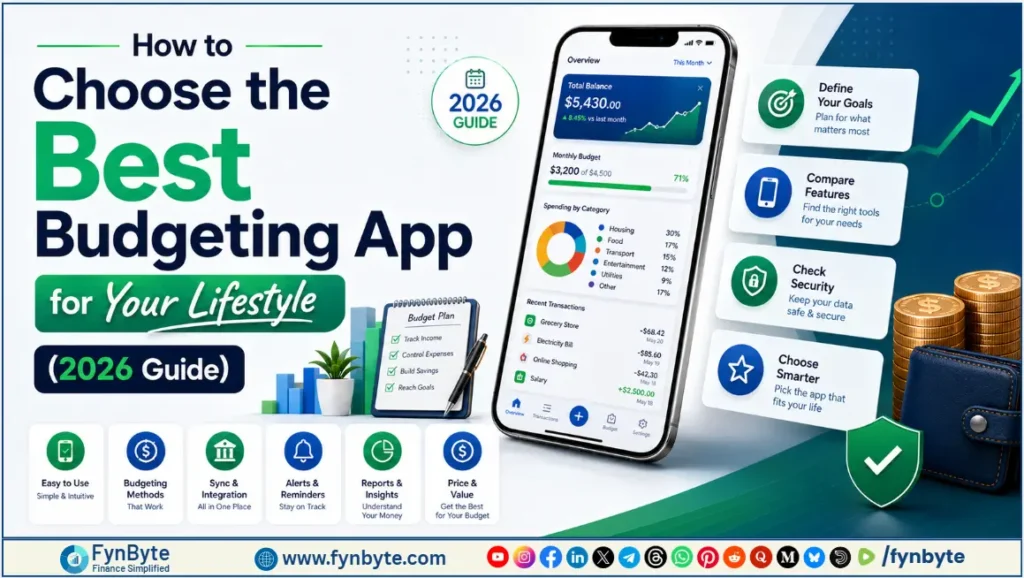
How to Choose the Best Budgeting App for Your Lifestyle (2026 Guide)
The Lifestyle Matrix: At a Glance
Before we dive into the deep psychological frameworks, here is a quick-reference matrix matching your current life stage to the absolute best software solutions on the market today:
| Your Lifestyle Persona | Ultimate Budgeting Goal | Best App Matches |
| The Active Planner & Debt Fighter | • Wants to destroy credit card debt. • Prefers manual control over every dollar. • Values intentional micro-budgeting. | • YNAB (You Need A Budget) • EveryDollar |
| The Busy Wealth-Builder | • Prefers high-level macro tracking. • Wants beautiful, automated background syncing. • Tracks investments alongside expenses. | • Monarch Money • Quicken Simplifi |
| The Frugal Minimalist / Student | • Wants zero monthly subscription costs. • Needs clean, basic automated bank syncing. • Focuses heavily on net worth growth. | • Empower • Rocket Money (Free Tier) |
| The Shared Finance Couple | • Wants joint financial tracking tools. • Needs separate logins with transparent goals. • Prefers in-app communication for bills. | • Honeydue • YNAB Together |
Persona 1: The Active Planner & Debt Fighter (The Hands-On Lifestyle)
If you constantly find yourself asking, “Where on earth did my paycheck go this month?”—you are an active planner who needs boundaries, not just charts.
Many traditional finance tools operate on a “passive tracking” model. They look backward, categorizing the money you spent last Saturday at a restaurant. For someone carrying credit card debt or living paycheck-to-paycheck, looking backward is a recipe for anxiety.
What You Need: Zero-Based Budgeting
You need an app built entirely around Zero-Based Budgeting (ZBB) or the digital envelope system. This methodology forces you to work exclusively with the money you have in your account today. Every single dollar is assigned a specific task (Rent, Insurance, Groceries) until your available balance hits zero.
The Top Choice: YNAB (You Need A Budget)
YNAB is the gold standard for this lifestyle. It doesn’t let you forecast future money, which prevents you from overspending. If you overspend in your “Dining Out” category, the app forces you to visually drag money out of another category (like “Clothing”) to balance the sheets. It is strict, it requires manual interaction, and it is incredibly effective at changing bad spending habits permanently.
Persona 2: The Busy Wealth-Builder (The Autopilot Lifestyle)
On the flip side, if your income is stable, you have cleanly automated your savings, and you find the idea of logging into an app every day to approve transactions incredibly tedious, you belong to the autopilot lifestyle.
You aren’t worried about bouncing a check; you are focused on optimizing your cash flow, checking your savings rate, and ensuring your retirement portfolios are moving in the right direction.
What You Need: High-Level Automation & Aggregation
You need a system with incredibly robust, multi-engine bank syncing that cleans up ugly merchant bank codes instantly. Your ideal app should function like an executive dashboard—giving you rich visual reporting, investment tracking, and predictive forecasting for the months ahead.
The Top Choice: Monarch Money or Quicken Simplifi
Monarch Money excels here with an incredibly clean, ad-free UI that tracks investments (401k, IRA, Crypto) alongside cash flow. Similarly, Quicken Simplifi provides a forward-looking “Spending Plan” that automatically subtracts your upcoming fixed bills from your income, telling you exactly how much safe “spending money” you have left for the month without requiring you to categorize every single latte.
Persona 3: The Frugal Minimalist (The Zero-Cost Lifestyle)
Let’s face it: paying a $100 to $150 annual subscription fee for an app just to figure out how to save money feels completely backward for many beginners, students, or strict minimalists.
If your financial situation is simple and you just want a reliable, secure way to keep an eye on your aggregate accounts without a line-item bill attached to it, you shouldn’t buy a premium app.
What You Need: Ad-Free, Safe Core Syncing
You need a platform that offers automated account syncing without hiding core tracking features behind aggressive premium paywalls.
The Top Choice: Empower Personal Dashboard
For users looking for a 100% free solution, Empower is unmatched. It securely links your bank and brokerage accounts, offering an elite net worth tracker, fee analyzers for your investments, and a robust retirement planner. The catch? Because it is free, the company makes its money by occasionally offering human wealth advisory services if your net worth crosses a certain threshold—but the software itself remains entirely free.
Persona 4: The Shared Finance Couple (The Collaborative Lifestyle)
Managing money with a partner is one of the leading causes of household arguments. If you are trying to sync finances with a spouse, using an app built for a single user usually leads to a communication breakdown.
One person ends up doing all the logging, while the other remains completely in the dark.
What You Need: Dual Logins and Joint Spaces
You need an app that natively supports collaboration—allowing two separate users to link their private bank accounts, view shared joint accounts, and comment on specific transactions within a shared space.
The Top Choice: Honeydue or YNAB Together
For a completely free mobile experience, Honeydue is custom-built for couples, allowing you to split bills and chat about specific expenses inside the app. For couples who want to adopt a serious, joint budgeting discipline, the premium YNAB Together feature allows a single subscription to be shared with up to six family members with completely customizable privacy barriers.
Unsure about the top premium choices? Read our deep-dive battle: YNAB vs Monarch Money (2026 Comparison).
The Tech Checklist Before You Download
Once you have identified your lifestyle persona, ask these three critical technical questions before typing your bank passwords into any interface:
- How is the data aggregated? Ensure the app uses secure, industry-standard, read-only aggregators like Plaid or Finicity. The app should never have the power to actually move or touch your money.
- Can I export my data? A great app never holds your data hostage. Ensure the platform allows you to export your entire history into a clean CSV format so you can transition smoothly if the company ever shuts down or changes its terms.
- Is there a desktop app? While mobile apps are great for tracking on the go, deep financial reviews and initial category setups are significantly easier to manage on a full-sized desktop monitor.
Check out our complete, verified review of the 10 Best Budgeting Apps in the USA to find customized options for every budget size.
Final Thoughts
Do not commit to a paid annual plan immediately. Every major premium personal finance tool on the market offers a trial period. YNAB offers a generous 34-day free trial, while Monarch Money gives you a 7-day test run.
Download the app that matches your lifestyle profile today, connect your accounts, and run it parallel to your life for a full billing cycle. If it feels like an annoying chore, delete it and switch to a different framework. The best budgeting app on earth is simply the one you actually enjoy using every single day.
Frequently Asked Questions (FAQs)
1. Is it worth paying for a budgeting app when free ones exist?
Yes, but only if your lifestyle demands it. Paid budgeting apps usually justify their price through advanced background bank syncing, AI-powered transaction categorization, and multi-device support for couples. If you are deeply in debt and need strict financial discipline (like YNAB provides) or have a complex portfolio (like Monarch tracks), paying for an app offers a massive return on investment. If you just want basic spending awareness, a free tracker is completely fine.
2. What is the easiest budgeting app for beginners to stick with?
For pure simplicity and a gentle learning curve, EveryDollar and Quicken Simplifi are the easiest apps to start with. They feature clean, highly intuitive mobile interfaces that don’t overwhelm you with financial jargon. If you want a hands-off experience where the software does all the work, Quicken Simplifi or Copilot automatically monitor your baseline expenses without requiring complex manual setups.
3. How do I choose between a “cash envelope” app and an “automated tracking” app?
Your choice depends on your psychological relationship with money. Choose a cash envelope/zero-based app (like YNAB or Goodbudget) if you struggle with impulse spending and need proactive boundaries before you swipe your card. Choose an automated tracking app (like Monarch or Simplifi) if you are already financially disciplined and simply want a passive, high-level bird’s-eye view of your monthly cash flow patterns.
4. Are budgeting apps safe from bank hacks and data breaches?
Reputable budgeting apps are highly secure because they utilize read-only access. This means apps connect to your accounts via secure financial aggregators like Plaid, Finicity, or MX using bank-grade 256-bit AES encryption. The apps never store your actual banking passwords, and they have absolutely zero technical capability to move, withdraw, or transfer money out of your accounts.
5. Can I use these apps if I still use physical cash for most purchases?
Yes, but you will need an app that prioritizes manual transaction entry. Apps like YNAB and EveryDollar are excellent for cash-heavy lifestyles because their entire system is optimized for you to manually input transactions on your phone right at the cash register. On the other hand, fully automated apps like Monarch Money lose a significant portion of their value if you do not link live digital bank accounts.
6. What should a couple look for when choosing a shared budgeting tool?
A couple should prioritize three non-negotiable features: dual-login support (so both partners can log in separately using their own credentials), transparent joint spaces (to manage shared household bills), and account privacy controls (to keep personal or gift accounts separate from the main household view). Honeydue offers this completely free, while YNAB Together and Monarch Money provide elite premium portals for households.
7. How long should I test a budgeting app before deciding it’s not working?
You should test a budgeting app for at least two full billing cycles (60 days). Financial habits take time to form, and your first month using any software will always feel chaotic due to setting up initial categories, adjusting boundaries, and dealing with irregular bills. Utilizing the 34-day trial of YNAB or standard premium free trials gives you the exact window needed to see if an app truly fits your lifestyle.